Team:
Sateesh N (Myself)
Vishwanath S
Viraj KN
and Umesh UG
Sateesh N (Myself)
Vishwanath S
Viraj KN
and Umesh UG
Tour Details:
Day 01- 01st April 2015 Left Bangalore by Train to Shivamogga [Bangalore Shivamogga Express (16201)] - Halt
Day 02- 02nd April 2015 Left Shivamogga by Car (Vishwa) enroute had breakfast reached Ganeshgudi by 12-00 pm-(visit to Old Magazine House for Bird Photography)
Day 03- 03rd April 2015 in and around Ganeshgudi
Day-04 -03rd April 2015 left Ganeshgudi reached Haliyal - Halt
visit to Kulgi Nature Camp- Safari
Day 05 -04th April 2015- Haliyal to Kulgi Nature Camp
and Haliyal to Hubli - back to Bangalore by Jan Shatabdhi Express (12080)
'Dandeli is a town in Uttara Kannada district of Karnataka, India, in the Western Ghats region in North Karnataka.
Dandeli Wildlife Sanctuary
Dandeli is a natural habitat for wildlife, including tigers, leopards, black panthers, elephants, gaur, deer, antelopes, and bears. It is the second largest wildlife sanctuary in Karnataka and was designated as a tiger reserve in 2007. The jungle is also home to several varieties of reptiles and almost 300 varieties of birds.The rapid expansion of industry has raised fears of ecological damage to the area, and local volunteer groups have formed to address the issue
Other attractions
The sanctuary provides rafting opportunities at the Virnoli Rapids connected to the Kali River. Other tourist activities include nature walks, boating, bird watching, crocodile spotting and angling. Nearby tourist spots include Ulavi, Syntheri Rocks, Anashi National Park, and Moulangi.
Ganeshgudi
 |
| RED WHISKERED BULBUL |
 |
| RED WHISKERED BULBUL |
DISTRICT:Uttara Kannada
PIN CODE:581365
BEST SEASON :Winter (October to February)
LANGUAGES:Konkani, Kannada, English and Marathi
STATE:Karnataka
WEATHER:Tropical weather. Hot in summer and moderately cool in winter
FAMOUS FOR/AS:Scenic
STD CODE:08383
COUNTRY:India
A scenic destination blessed with breath taking natural beauty, Ganeshgudi is located in Uttara Kannada district of Karnataka and lies in lush green forest ranges of the Western Ghats on the banks of River Kali. It is blessed with rich flora and fauna and is well known for its adventure sports and eco-tourism.
It is a perfect place to absorb the natural beauty and panoramic views of the destination. Ganeshgudi Travel Guide is full of references of the mesmerizing sceneries and serene spots around the area. Sri Mallikarjuna Temple, Dandelappa Temple, Anshi National Park, Dandeli Wildlife Sanctuary, Supa Dam and Kulgi Nature Camp are the famous tourist destinations of this region. An exciting tour to Ganeshgudi assures a rewarding and memorable experience for all wildlife enthusiasts, nature lovers and bird lovers.
Accommodation in Ganeshgudi
There are a lot of deluxe and medium to budget accommodation options near Ganeshgudi. Hornbill River Resorts (Ganeshgudi-Joida Taluk), Sangway Holiday Homes (Village: Kerwad), Bison River Resort (Village- Ilva), Old Magazine House Forest Camp (Ganeshgudi), Jungle Lodges Kali Wilderness Camp (Dandeli) and Stanley Farm House (Gobral Village) are the famous deluxe hotels of city and newly opened WHISTLING WOODS
Some of the medium to budget accommodation include Anshi Nature Camp (Anshi Village), Dandeli Jungle Inn (Link Road Parallel), Kamat Yatri (Jawaharlal Nehru Road) and Amara Homestay (Near Syntheri Rocks) etc.
How to Reach Ganeshgudi
Ganeshgudi by Air
The nearest International Airport is Dabolim Airport, Goa, roughly three hour drive from Ganeshgudi. Dabolim Airport is well connected to a spectrum of cities such as Delhi, Bangalore, Hyderabad, Chennai, Chandigarh, Ahmedabad, Pune and Lucknow via Air India, Spice Jet, Indigo, Go Air, Jet Airways and Jet Konnect.
Ganeshgudi by railways
The nearest Railway Station is Karwar Railway Station, roughly 108 Kms from Ganeshgudi which is connected to the major cities of India like New Delhi, Bangalore, Mysore, Lucknow, Chennai, Kanyakumari, Ahmedabad, Jaipur, and Patna.
Ganeshgudi by road
Ganeshgudi is 67 Kms from Dharwad, 75 Kms from Belgaum, 84 Kms from Hubli, 103 Kms from Karwar, 115 Kms from Uttara Kannada, 150 Kms from Gadag, 206 Kms from Bagalkot and is linked via Karnataka State Road Transport Corporation (KSRTC) and some private travel services.
Distance Charts to Ganeshgudi
Bagalkot to Ganeshgudi 4 hours 2 mins211 km
Belgaum to Ganeshgudi 1 hour 31 mins75.4 km
Hubli to Ganeshgudi 1 hour 52 mins84.2 km
Uttara Kannada to Ganeshgudi 2 hours 23 mins115 km
Ganeshgudi – Hornbill extravaganza
For the first couple of days we stayed at the Hornbill River Resort (6 kms from Ganeshgudi, adjacent to the Bison River Resort). The location is unbelievably beautiful and offers amazing view of the Kali river. The morning views are stunning when the mist from the river creates a magical effect. True to its name, this place offer excellent sightings of the Malabar Pied Hornbill and Malabar Grey Hornbill. Both are seen in abundance within the campus feeding on fruits. Another must-watch here is the Hornbill Crossing – a routine of these majestic birds crossing across the Kali river every evening. Across the river one often can see the Lesser fish eagle and the Black-capped Kingfisher (amongst other birds). These are best seen on a boat/raft ride. Besides bird-watching we also experienced the adrenaline rush of river rafting here, traversing through some 10 rapids (3+ grade) on the Kali River.
Summer season in Ganeshgudi
 |
| MALABAR PIED HORNBILL |
Summer season in Ganeshgudi
The summers in Ganeshgudi are hot and generally avoided by the tourists. The month of April marks the start of summer season and it lasts till June. Temperature ranges between 30°C to 36°C during these months.
 |
| MALABAR PIED HORNBILL- FLIGHT |
Monsoon season in Ganeshgudi
Ganeshgudi experiences monsoons between the months of July to October. Moderate rainfall is the characteristic of the season.
 |
| KINGFISHER |
Winter season in Ganeshgudi
The Month of November marks the start of the winter season in Ganeshgudi. Temperature ranges between 17°C to 29°C. Winters last till February in Ganeshgudi. This is one of the best seasons to visit Ganeshgudi as the place seems washed and beautiful after the rains.
Old Magazine House Forest Camp - Ganeshgudi

Where nature meets excitement
 |
| OLD MAGAZINE HOUSE COTTAGES |
The Old Magazine House Forest Camp, a unit of Jungle Lodges and Resorts Ltd., Bangalore, is located on Londa to Dandeli Road in Joida Taluk, Karnataka. The Old Magazine House used to be an ammunition dump for storing dynamite nearly 20 years ago.
 |
| PHOTOGRAPHERS QUE IN OLD MAGAZINE HOUSE |
 |
| GREY WAGTAIL |
Hot Spot for Nature Enthusiasts
The Old Magazine House is a haven for nature enthusiasts and travelers seeking solitude. If peace and tranquility is what you are looking for, the forest camp here will be the ideal vacation destination for you.
 |
| BLACK NAPED MONARCH FLYCATCHER |
 |
| BLACK NAPED MONARCH FLYCATCHER |
The camp is surrounded by an extensive reserve forest and perched at an altitude of 1,800 feet. The climate remains salubrious round the year.
The camp originally had only two warehouses. JLR has added a string of bamboo huts between the two red-hued structures. One has been converted into a dormitory and kitchen with a dining area on its covered terrace while the other is used to store adventure sports equipment and doubles as living quarters for British guides who oversee all outdoor activities.
 |
| ASIAN PARADISE FLYCATCHER |
 |
| ASIAN PARADISE FLYCATCHER |
 |
| LITTER SPIDER HUNTER |
 |
| RUSTY TAILED FLYCATCHER |

 |
| WHITE EYE |
 |
| White Bellied blue fly catcher |
As night falls, the ambience wears a different hue. Hurricane lamps strung from poles beside the huts mark their positions in the dim campsite. Electricity is used sparingly and the surrounding forest comes alive with night sounds.
 |
| BLUE FLYCATCHER |
 |
| Bathing Birds |
Getting there
A left turn at the Hubli bypass, another 25 km ahead and you reach the Goa road. A right turn next 3 km ahead and at Narayanpura another right turn will lead straight to Dandeli. Finally, a last stretch of 25 km and you are in Ganeshgudi.
 |
| ASIAN PARADISE FLYCATCHER |
For the adventure sport buffs, the camp offers a host of activities such as white water rafting on Kali river, kayaking, canoeing, mountain biking, jungle safaris and trekking are the other activities.
 |
| YELLOW BROWED BULBUL |
 |
| YELLOW BROWED BULBUL |
 |
| YELLOW BROWED BULBUL |
If making peace with nature is your mission, you can go for a slow coracle ride on the placid stretches of the river to view crocodiles and water birds, enjoy languorous elephant rides into the jungle or angling by the riverside.
source: http://www.dandeli.com/resorts/om-forest-camp.php#.VSHcxfmUe5I
Foreigner Indian
Ethnic Cottage 3,992.00 2,648.00
Dormitory 3,068.00 1,725.00
Since Dormitory is under upgradation, they provide accommodation in Kali Adventure Camp till 25th Jan 2015, transportation would be provided.
Tariffs are per person per night on twin-sharing basis.
Package Includes: Stay, Lunch, Dinner & Breakfast, Guided Trekking, Camping, Jungle/Boat safari at extra cost. Luxury tax (4,8 or 12%) on lodging, VAT (14.5%) on boarding, Service tax (12.36%) on 70% of basic and Forest entry charges.
Notes
Tariffs are per person per night on twin-sharing basis.
Transfers to & from our resorts are not included in the tariff.
Single occupancy charges are applicable.
Tariff for children (accompanying parents) between 5 and 12 years is 50% discount on the tariff.
Tariff May be changed without prior notice
Resort Contact info
Ganeshgudi,nearest Camp-1, Joida Taluk,Londa-Dandeli Road
Around Karwar - 581365 Near Goa, India
Manager: Mr. Mohan Babu
Contact Number: 9448611387
Land-line: 08383-256301
Email Id: omh@junglelodges.com
 |
| MALABAR GIANT SQUIRREL |
 |
| MALABAR PIED HORNBILL |
Foreigner Indian
Ethnic Cottage 3,992.00 2,648.00
Dormitory 3,068.00 1,725.00
Since Dormitory is under upgradation, they provide accommodation in Kali Adventure Camp till 25th Jan 2015, transportation would be provided.
Tariffs are per person per night on twin-sharing basis.
Package Includes: Stay, Lunch, Dinner & Breakfast, Guided Trekking, Camping, Jungle/Boat safari at extra cost. Luxury tax (4,8 or 12%) on lodging, VAT (14.5%) on boarding, Service tax (12.36%) on 70% of basic and Forest entry charges.
Notes
Tariffs are per person per night on twin-sharing basis.
Transfers to & from our resorts are not included in the tariff.
Single occupancy charges are applicable.
Tariff for children (accompanying parents) between 5 and 12 years is 50% discount on the tariff.
Tariff May be changed without prior notice
 |
| MALABAR PIED HORNBILL |
Resort Contact info
Ganeshgudi,nearest Camp-1, Joida Taluk,Londa-Dandeli Road
Around Karwar - 581365 Near Goa, India
Manager: Mr. Mohan Babu
Contact Number: 9448611387
Land-line: 08383-256301
Email Id: omh@junglelodges.com
 |
| White Rumped Shama |
Birds can be sighted in and around Ganeshgudi, Kulgi, Dandeli:
Golden Oriole | Tailor Bird | Peacock | ||
Pompador Green Pigeon | Black Kite | Small Blue Kishfisher | ||
Black Winged Stilt | Brahminy Kite | Stork Billed Kingfisher | ||
Common Sandpiper | Blue Rock Thrush | White Breasted Kingfisher | ||
Asian Koel | Chestnut Tailed Starling | Chestnut Headed Bee-eater | ||
Coppersmith Barbet | Common Myna | Lesser Fish Eagle | ||
White Cheeked Barbet | Spotted Munia | Crested Serpent Eagle | ||
Cattle Egret | Spotted Dove | Green Pigeon | ||
Pond Heron | Indian Roller | Gold Fronted Leafbird | ||
Yellow Browed Bulbul | Green Bee Eater | Red Whiskered Bulbul | ||
Asian Brown Flycatcher | Common Iora | Pied Wagtail | ||
Asian Paradise Flycatcher | Black Lored Tit | Tickels Blue Flycatcher | ||
Warblers | Velvet Fronted Nuthatch | Tickels Flowerpecker | ||
Purple Sunbird | Greater Flameback WP | Greater Coucal | ||
Purple Rumped Sunbird | Lesser Flameback WP | Rufous Treepie | ||
Plum Headed Parakeet | Darter | Grey Wagtail | ||
Scarlet Minivet | Cormorant | Bay-backed Shrike | ||
Malabar Pied Hornbil | Black Drongo | Red-vented Bulbul | ||
Malabar Grey Hornbill | Hill Myna | Puff Throated Babbler | ||
Jungle Babbler | Oriental Magpie Robin | Tawny Bellied Babbler | ||
Ashy Drongo | Rose Ringed Parakeet | Flying Squirrel | ||
Racket Tailed Drongo | House Sparrow | Malabar Gaint Squirrel | ||
White Breasted Waterhen | Great Tit | Oriental White-eye | ||
Red Wattled Lapwing | Malabar Whistling Thrush | Swallow | ||
White Rumped Munia | Shikra | Small Minivet | ||
Swift | Black Shouldered Kite | Brown Shrike | ||
Brown headed Barbet | Blue Rock Pigeon | Jungle Myna |
 |
| MALABAR PIED HORNBILL |
Supa Dam is built across Kalinadi (Kannada) or Kali river in state of Karnataka in India. The dam is situated in Joida taluk of Uttara Kannada district. The power house at the foot of the dam has two electricity generators of fifty megawatt each.


The electricity generated is supplied to different parts of Karnataka. The dam was built by Hindustan Steel Works Construction Limited (HSCL) and is now operated by Karnataka Power Corporation Limited. The power house was commissioned in 1985.
 |
| SUPA DAM |
The construction started in 1974 and ended in 1987. It has a gross storage capacity of 4178 Mcum and a live storage of 4115.25 Mcum of water. It is designed having two generators of 55 MVA and has a generator voltage of 11KV. The entire generator output accounts for 100 MW of electricity with 2916 Terminal Amp/unit and a line voltage of 110 KV. They generate about 542 Million Units annually. The output four lines of the grid are distributed between the substations at Ponda and Ambewadi equally. It is a concrete gravity dam with a height of 101 m and length of 332 m with 3 radial gates of 15m x 10m dimension and has vertical Francis turbines with a design head of 72 m.


Kulgi – Camping in nature’s lap


Kulgi nature camp was our second destination where we camped for 3 nights. This is probably the best place to camp around. The camp is situated in the forest and is a great location for birdwatching. You can see birds practically everywhere (behind the tents, enroute the watch tower, Inspection Bungalow). The best experience we had were with the mixed hunting parties when for 10-15 mins birds of different species are seen in large numbers. Typically this includes Drongos, Woodpeckers, Nuthatches, Starlings, Babblers amongst others. In addition to these we had good sightings of Woodpeckers (Greater-flameback and Yellow Crowned Pygmy) and our favourite – Asian Paradise Flycatcher right behind our tent. The forest department offers jungle safari here, but ours (like most evening safaris here) did not prove very productive. Our lone sighting was a Gaur (which most others did not). Though one can supposedly sight the black panther and the tiger in this sanctuary, we did not come across a single deer/chital.


Besides the surroundings we visited the backwaters of the Bommanahalli dam and the Dandeli Timber mart. The former did not yield any special sightings and was a bit of a letdown having walked 7 kms in early hours of morning. The later was a great place to sight the hornbills but our experience was slightly truncated by heavy fog early morning. Nevertheless this place offered great sightings of the Roller, Barbets and a number of small (still unidentified) birds.

Some things to note
- For bird watching, it really helps to have your own vehicle here. Not having one imposed a major constraint for us.
- Private transport (typically Jeeps) is exorbitantly expensive. Public transport is cheap but intermittent.
- Distances are long. More often than not distances are much greater than those indicated by locals.
- Hornbill camp offers tree house, log huts, rock huts and rooms at the same cost (please verify). Try to book the tree house, it is excellently located. The standard rooms are a pithy in comparison.
- Bookings for the Kulgi Nature Camp need to be made through the forest department in Dandeli (Phone-, Fax-). Advance payment towards accommodation must be made via a draft drawn in favor of “The Deputy Conservator of Forests, Dandeli”. State Bank of Mysore has a branch in Dandeli.
- Kulgi Nature camp is very economical. It offers standard/deluxe tents in addition to dormitories. The deluxe tents come with attached toilets. All tents have electrical points for charging camera batteries/laptops.
- Though cheap, Kulgi Nature Camp offers very clean accommodation. Remember to carry your own towels and toiletries. Reasonably good food is available in the campus at a additional cost.
- There is no mobile network/phone connectivity at Kulgi.
- The temperatures at Dandeli, Ganeshgudi and Kulgi can vary. For us, Ganeshgudi was very cold in comparison to Kulgi.
 |
| Due To Summer, Langoor taking a NAP, near KULGI |
 |
| BADA LANGOOR- KULGI |
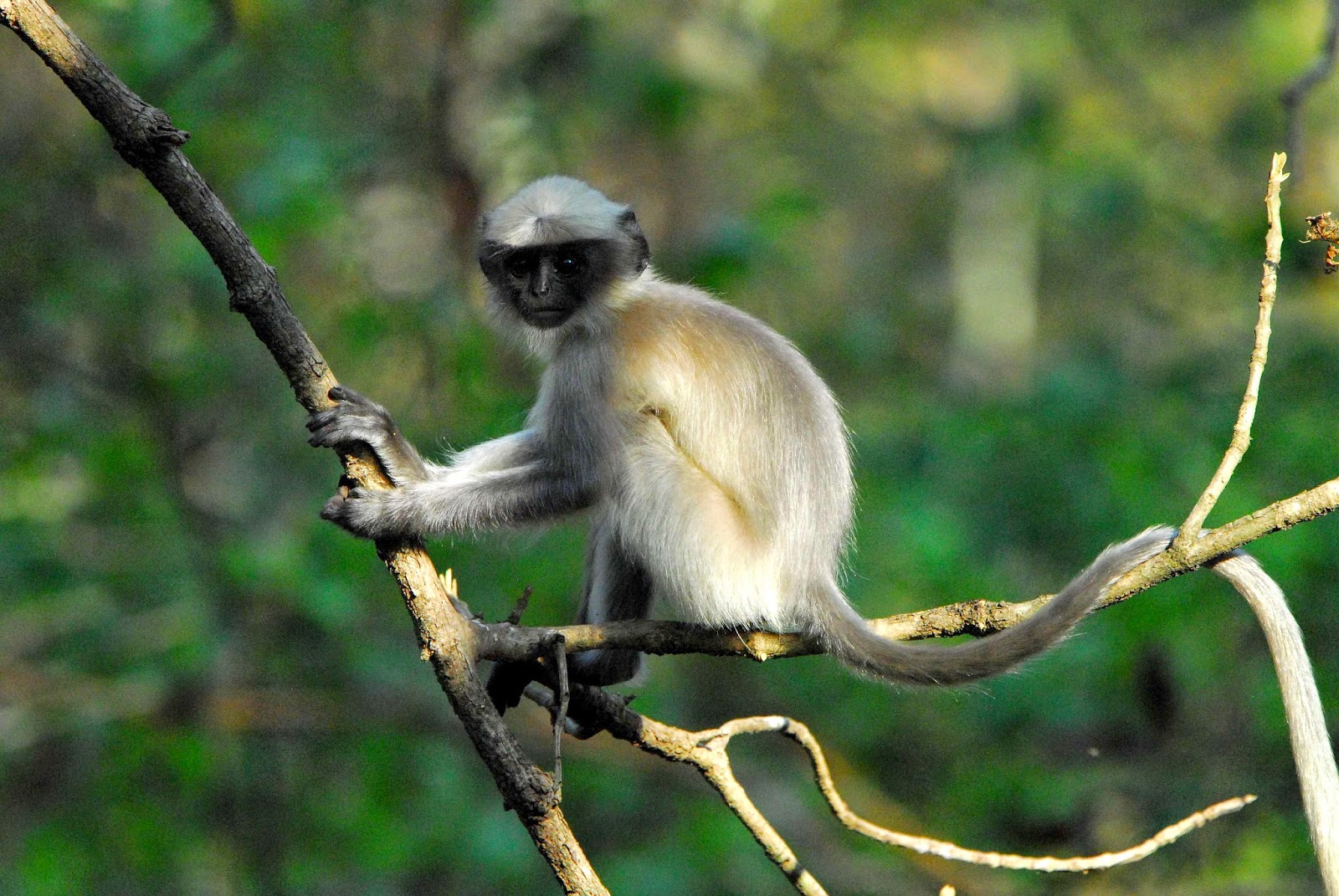 |
| CHOTA LANGOOR- KULGI |
 |
| SPOTTED DEER -KULGI |
 |
| PEACOCK-KULGI |
 |
| MALABAR GIANT SQUIRREL |
 |
| FLYING SQUIRREL - KULGI |
 |
| FOUR MUSKEETEERS |